In these times you have to be an optimist to open your eyes when you wake in the morning. ~ Carl Sandburg
Hello friends,
Our work continues to fund, research, produce and air on national PBS a documentary film that capture the spirit and story of Carl Sandburg's unique life and vision of America.
The long awaited response came from The National Endowment for the Humanities with the bottom line of no funding. But above that bottom line was abundant optimism for the subject, ideas, how our proposal was written and the team assembled. Here are a few quotes from the panel of reviewers:
"The proposal makes a a good case for the 'humanities' relevance of Sandburg's life... I think this biography would have great, broad appeal. It illuminates an important aspect of American culture."
"The team Bonesteel has assembled is the impressive thing about this proposal."
"The music sound bed will add remarkable texture to the story. The diverse range of participants who have agreed to be interviewed is impressive."
"I was please to see that Sandburg's political complexities and his lesser known ties to the world of folk music will be addressed as well, since these might broaden the life, times and contributions to American letters, and I found the treatment included with the proposal compelling."
We continue on seeking funding and may very well apply again to the NEH, NEA and others that have favorably reviewed our plans but have failed to fund us. As many of you know I see this project as a long haul... a tough road that we will cover in good time.
Thursday, July 13, 2006

Wednesday, March 29, 2006
'Don't forget about Paula'
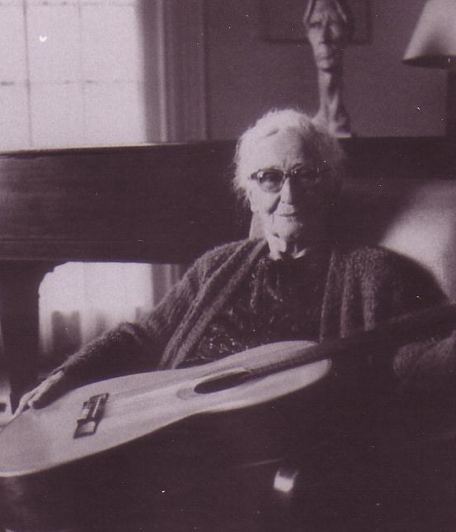
During virtually every conversation with people who knew the Sandburgs or even people who have only read about them usually the comment comes "Don't forget about Paula".
Lilian Steichen Sandburg or ‘Paula’ was Carl's wife and 'comrade' in the socialist movement when they met. She typed his poems and mailed them into the earliest publications that started his career. She mothered and cared for his children and household while he was traveling from stage to stage or was hunkered down writing volumes of work.
She had homes built and renovated. She withstood his enormous popularity and became a highly respected breeder of goats, winning prizes and making milk while he met with presidents and performed on television.
Everyone who knew her spoke about her much the same way Carl did, that she was an angel of wisdom, competence and companionship.
She, very tangibly, helped make Sandburg the iconic figure he is today and will not be forgotten in our telling of his story.
Friday, February 10, 2006
the marvelous rebellion of man
Carl's poem "Who Am I?" (below) was certainly not intended to express the public awareness of his work here in 2006, but something more significant, the 'elusive captive' of truth. Poetry does not fully explain itself, by its nature it too is elusive.
Some days in this process I look at what I expect, and what others think this project should be and I want to trash the signs (and scripts from the past) that tell me what to do. It's long been my belief and philosphy that how you tell a story should be based (in part) on the character and style of the subject itself. These trace elements of insight and history help to mold and shape the outcome. That is why there are two large piles of books and folders on my desk. Seven different biographies of Sandburg, one of Bob Dylan, original editions of his Lincoln biography... even the texture of the paper and binding say something about the work and period it was written. It is an on-going search for the truth, or as close as you can get to expressing the essential elements of the subject.

WHO AM I?
My head knocks against the stars.
My feet are on the hilltops.
My finger-tips are in the valleys and shores of
universal life.
Down in the sounding foam of primal things I
reach my hands and play with pebbles of
destiny.
I have been to hell and back many times.
I know all about heaven, for I have talked with God.
I dabble in the blood and guts of the terrible.
I know the passionate seizure of beauty
And the marvelous rebellion of man at all signs
reading "Keep Off."
My name is Truth and I am the most elusive captive
in the universe.
Carl Sandburg
(From Chicago Poems, In public domain)
Some days in this process I look at what I expect, and what others think this project should be and I want to trash the signs (and scripts from the past) that tell me what to do. It's long been my belief and philosphy that how you tell a story should be based (in part) on the character and style of the subject itself. These trace elements of insight and history help to mold and shape the outcome. That is why there are two large piles of books and folders on my desk. Seven different biographies of Sandburg, one of Bob Dylan, original editions of his Lincoln biography... even the texture of the paper and binding say something about the work and period it was written. It is an on-going search for the truth, or as close as you can get to expressing the essential elements of the subject.
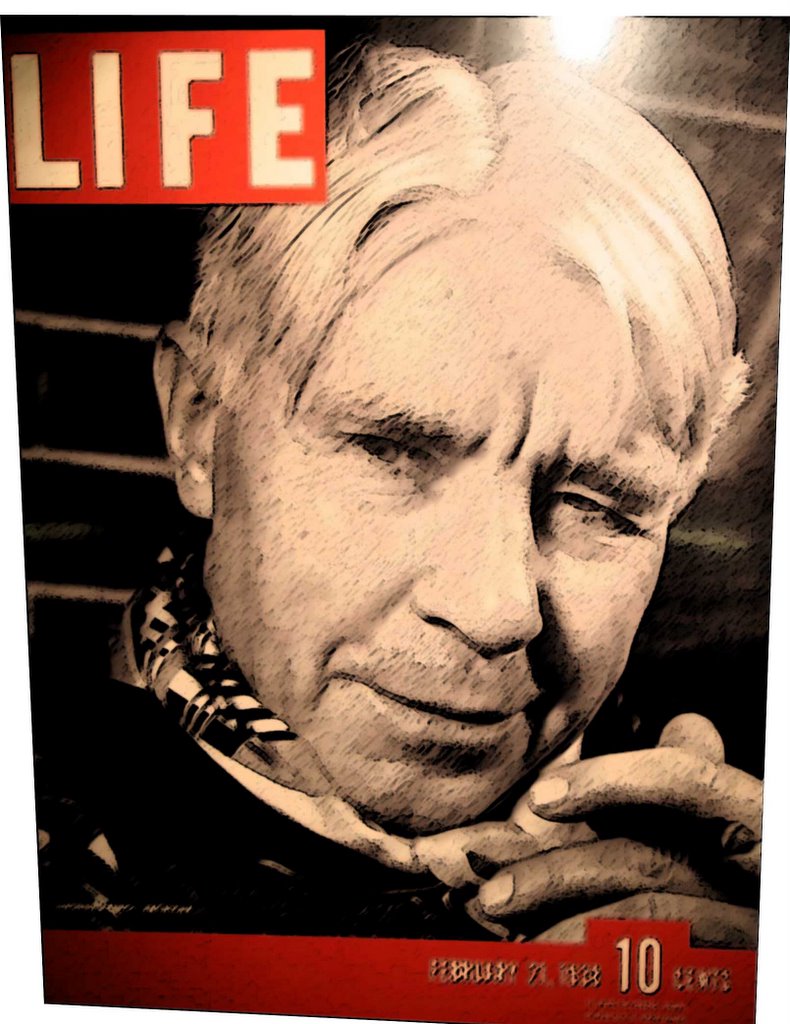
WHO AM I?
My head knocks against the stars.
My feet are on the hilltops.
My finger-tips are in the valleys and shores of
universal life.
Down in the sounding foam of primal things I
reach my hands and play with pebbles of
destiny.
I have been to hell and back many times.
I know all about heaven, for I have talked with God.
I dabble in the blood and guts of the terrible.
I know the passionate seizure of beauty
And the marvelous rebellion of man at all signs
reading "Keep Off."
My name is Truth and I am the most elusive captive
in the universe.
Carl Sandburg
(From Chicago Poems, In public domain)
Saturday, January 28, 2006
Subject matter. Really.
What's this story about ? Really?
It's a question I ask myself quite a bit. I consider all the poems, books, photographs, stories of Sandburg, comments made in passing, by noted critics or by strangers I meet at the coffee shop. I think about the century that has passed and what remains important? Where are the lessons in the lives of others and the past?
Here are some things that bounce back at me. Democracy. Creativity. Study. Music. Reality. Optimism. Fantasy. Expression. Struggle. Truth.
Democracy: His countless writings about politics, socialism, racism, Lincoln, the Wars, American History.
Creativity: His seemingly limitless ability to conjure up a new style, method, subject.
Study: His fascination with details, inovations and exploration of complex subjects.
Music: His passion for collecting, publishing and singing some of Americas most beloved songs.
Reality: His life that was grounded by basic faith in the people.
Optimism: His believing that within those people, is goodness (along with everything else).
Fantasy: He took children's literature to a new place of exaggeration and nonsense...
Expression: As only a poet can, saying things that need to be said.
Struggle: Celebrating the struggle of existence, and not giving in to complacency.
Truth: Always searching... 'Where to? What next?"
I think about these ideas and what we can learn through Sandburg's experience. I think about my early childhood visits to the big white house with goats and books and guitars... and I think about expressing those things forward to the next generation.

My Son, Jonah Bonesteel at the Carl Sandburg National Historic Site, Flat Rock, NC
It's a question I ask myself quite a bit. I consider all the poems, books, photographs, stories of Sandburg, comments made in passing, by noted critics or by strangers I meet at the coffee shop. I think about the century that has passed and what remains important? Where are the lessons in the lives of others and the past?
Here are some things that bounce back at me. Democracy. Creativity. Study. Music. Reality. Optimism. Fantasy. Expression. Struggle. Truth.
Democracy: His countless writings about politics, socialism, racism, Lincoln, the Wars, American History.
Creativity: His seemingly limitless ability to conjure up a new style, method, subject.
Study: His fascination with details, inovations and exploration of complex subjects.
Music: His passion for collecting, publishing and singing some of Americas most beloved songs.
Reality: His life that was grounded by basic faith in the people.
Optimism: His believing that within those people, is goodness (along with everything else).
Fantasy: He took children's literature to a new place of exaggeration and nonsense...
Expression: As only a poet can, saying things that need to be said.
Struggle: Celebrating the struggle of existence, and not giving in to complacency.
Truth: Always searching... 'Where to? What next?"
I think about these ideas and what we can learn through Sandburg's experience. I think about my early childhood visits to the big white house with goats and books and guitars... and I think about expressing those things forward to the next generation.
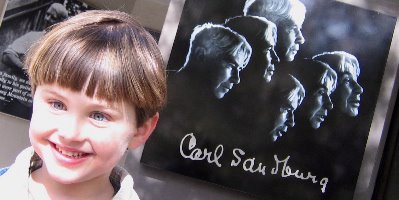
My Son, Jonah Bonesteel at the Carl Sandburg National Historic Site, Flat Rock, NC
Wednesday, January 18, 2006
New York City Sandburg, and other thoughts
In 1949 Alan Lomax took Carl Sandburg to see Pete Seeger and The Weavers play in New York's Village Vanguard club. Many nights in the late 1950's on the upper east side Sandburg would sing at eclectic impromptu parties held at the house of Terry and Gregory d'Allesio. And it was at the Museum of Modern Art with his brother-in-law Edward Steichen that he would collaborate on the landmark photographic exhibit The Family of Man. Sandburg may have captured Chicago in poems but he knew and loved New York.

In New York we interviewed Terry d'Alessio, Joanna Steichen, and the incomparable Pete Seeger, telling these stories and more for our documentary.
Our flight home from Newark followed the spine of the Appalachian mountains and snaking along the top I could see the Blue Ridge Parkway like a pathway leading us back to Asheville. On my I-pod I listened to an artist who is relatively new to me, a guy named Sujfan Stevens. His latest recording has a song on it that is titled (in part) ...Carl Sandburg came to me in a dream... with this bouncing around my head as the plane bumped and shifted in the winter air I was encouraged that someone like him would find inspiration in Sandburg. The record is beautiful and bizarre, melodic and challenging. Check it out.
After coming home I was listening to XM radio when a song by Pete Seeger's band The Weavers came up called Sinnerman. It was familiar... but not. I was confused. I thought this was a Peter Tosh song... but no, it's a traditional American song brought back in the 1950's by The Weavers and then recorded by The Wailers, and then Peter Tosh.
What does this have to do with Sandburg? We'll, it's just my continual realization that these things are connected. Like Pete Seeger says, "they are links in the chain" and the Peter Tosh version that I knew was made possible (in part) by The Weavers (and no doubt many others) recording it and others collecting the songs in the first place. Like Sandburg's American Songbag.
Photo by Evan Schafer: Director Paul Bonesteel talking with Pete Seeger

In New York we interviewed Terry d'Alessio, Joanna Steichen, and the incomparable Pete Seeger, telling these stories and more for our documentary.
Our flight home from Newark followed the spine of the Appalachian mountains and snaking along the top I could see the Blue Ridge Parkway like a pathway leading us back to Asheville. On my I-pod I listened to an artist who is relatively new to me, a guy named Sujfan Stevens. His latest recording has a song on it that is titled (in part) ...Carl Sandburg came to me in a dream... with this bouncing around my head as the plane bumped and shifted in the winter air I was encouraged that someone like him would find inspiration in Sandburg. The record is beautiful and bizarre, melodic and challenging. Check it out.
After coming home I was listening to XM radio when a song by Pete Seeger's band The Weavers came up called Sinnerman. It was familiar... but not. I was confused. I thought this was a Peter Tosh song... but no, it's a traditional American song brought back in the 1950's by The Weavers and then recorded by The Wailers, and then Peter Tosh.
What does this have to do with Sandburg? We'll, it's just my continual realization that these things are connected. Like Pete Seeger says, "they are links in the chain" and the Peter Tosh version that I knew was made possible (in part) by The Weavers (and no doubt many others) recording it and others collecting the songs in the first place. Like Sandburg's American Songbag.
Photo by Evan Schafer: Director Paul Bonesteel talking with Pete Seeger
Monday, January 09, 2006
Helga
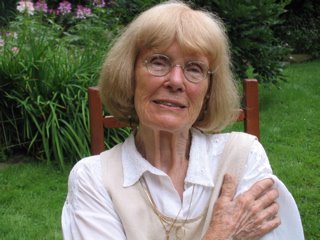
I think that while Chicago Poems are great, and all of his poems are great, there's something about The People, Yes where he really knocked himself out. At the time when the country was at war, and he stopped what he was doing and he wrote this great thing for the people, I think that was important.
-Helga Sandburg Crile
It was July 2004, and we had just shot for five days in Marion, Indiana on our last documentary The Great American Quilt Revival (which is airing currently around the country on PBS). It was raining hard as Evan and I drove into Cleveland to sleep for the night. The dark skies and tired eyes played havoc on the driver, but we made it safely to a bed.
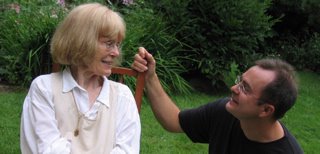
The next day was the first interview we conducted on this project, which, even then, had taken years to make happen. It was with Helga Sandburg Crile, Carl and Paula Sandburg's third and only surviving daughter. I started correspondance with her back in 1992 and she was kind to entertain my inquiries and poetry. We arrived at her house to barking and playful dogs, flowers blooming throughout the garden and a welcoming subject.
Here she is discussing her father and uncle, the photographer Edward Steichen.
Helga has been, since an early age, 'Carl Sandburg's daughter'. She enjoyed it, rebelled against it and ultimately became a creative force herself writing many books of poetry, fiction and biography. Sitting and talking with her you can see it in her eyes, hear it in certain words and phrases, bits and samples of her Father's personality.
Her interview was delightful, sentimental, revealing and surprisingly straightforward in her opinions on the life of her Father and where he fits into the 20th century literary history. Reading books that other people have written about him can sometimes separate Sandburg the real person from the character he becomes when you read about him. In moments like this all of that changes. Real people write, real people make history, real people become the characters we read about later. For Helga, we were talking about her dad... And once again a hundred years or more were compressed down to a mere instant.
But, you know, just go back to his Complete Poems. And if you have a child that is able to read, just a little bit, give him The Complete Poems. Don't tell him what he should read, and what poem is right for a child, for heaven's sake. Let the child go.
-Helga Sandburg Crile
And that is why I love what I do.
Tuesday, December 27, 2005
The Great Hunt
I cannot tell you now;
When the wind's drive and whirl
Blow me along no longer,
And the wind's a whisper at last--
Maybe I'll tell you then--
some other time.
When the rose's flash to the sunset
Reels to the rack and the twist,
And the rose is a red bygone,
When the face I love is going
And the gate to the end shall clang,
And it's no use to beckon or say, "So long"--
Maybe I'll tell you then--
some other time.
I never knew any more beautiful than you:
I have hunted you under my thoughts,
I have broken down under the wind
And into the roses looking for you.
I shall never find any
greater than you.
Carl Sandburg
Two days after Christmas 2005, and I'm listening to 'The Band'. Music that was made forty years ago that sounds as fresh and authentic as anything that is being made today. Which brings up an important topic, what constitutes 'greatness' in music, poetry or otherwise?
Today if you bring up Carl Sandburg's poetry in academic circles some accuse it of being "period poetry", "too simple" or even "propaganda". His poems are not being taught in schools as they once were, many have been removed from anthologies. There is a fairly consistent record of him being criticized both before and after his death in 1967 for any number of reasons.
But if you do a google 'blog' search you'll see thousands of references to Sandburg and his poetry in people's thoughts and postings. His work does still resonate today. People who read him remember the imagery and ideas... It still 'works' as poetry for many. Sandburg never sought the approval of the academic poets, but he dabbled in their thoughts and criticisms it did mean something to him. There will be a component to this debate in our documentary; where did the reputation of Sandburg go and why? Did his popularity eclipse his work? I welcome thoughts on this topic. What poems still 'work' for you? And why? Click on the link on the title above for a site with Sandburg's Chicago Poems (in public domain), take a read.
Come on people where are you?
When the wind's drive and whirl
Blow me along no longer,
And the wind's a whisper at last--
Maybe I'll tell you then--
some other time.
When the rose's flash to the sunset
Reels to the rack and the twist,
And the rose is a red bygone,
When the face I love is going
And the gate to the end shall clang,
And it's no use to beckon or say, "So long"--
Maybe I'll tell you then--
some other time.
I never knew any more beautiful than you:
I have hunted you under my thoughts,
I have broken down under the wind
And into the roses looking for you.
I shall never find any
greater than you.
Carl Sandburg
Two days after Christmas 2005, and I'm listening to 'The Band'. Music that was made forty years ago that sounds as fresh and authentic as anything that is being made today. Which brings up an important topic, what constitutes 'greatness' in music, poetry or otherwise?
Today if you bring up Carl Sandburg's poetry in academic circles some accuse it of being "period poetry", "too simple" or even "propaganda". His poems are not being taught in schools as they once were, many have been removed from anthologies. There is a fairly consistent record of him being criticized both before and after his death in 1967 for any number of reasons.
But if you do a google 'blog' search you'll see thousands of references to Sandburg and his poetry in people's thoughts and postings. His work does still resonate today. People who read him remember the imagery and ideas... It still 'works' as poetry for many. Sandburg never sought the approval of the academic poets, but he dabbled in their thoughts and criticisms it did mean something to him. There will be a component to this debate in our documentary; where did the reputation of Sandburg go and why? Did his popularity eclipse his work? I welcome thoughts on this topic. What poems still 'work' for you? And why? Click on the link on the title above for a site with Sandburg's Chicago Poems (in public domain), take a read.
Come on people where are you?
Thursday, December 15, 2005
Interview with Studs
You wonder these days about 'The People Yes'... the way we've been going, perhaps I'd re-title it 'The People Perhaps' or 'The People Maybe'.
-Studs Terkel, interview, Chicago, 11.10.05

Photo: Director Paul Bonesteel talks with Studs Terkel. (Studs had just listened to a recording of an interview he conducted with Carl Sandburg in 1959)
Meeting and interviewing Studs Terkel was humbling to say the least. To interview someone who has done the same with many of the most influential people of the 20th century, was exciting and fulfilling. Studs read from Sandburg's poetry, stopping between lines to make comments and, in fact, doing a bit of Sandburg impersonation. He was especially good with his version of "The Peeeeeeeople, Yes".
I am grateful to Studs for opening his door to us and telling us his stories.
-Studs Terkel, interview, Chicago, 11.10.05
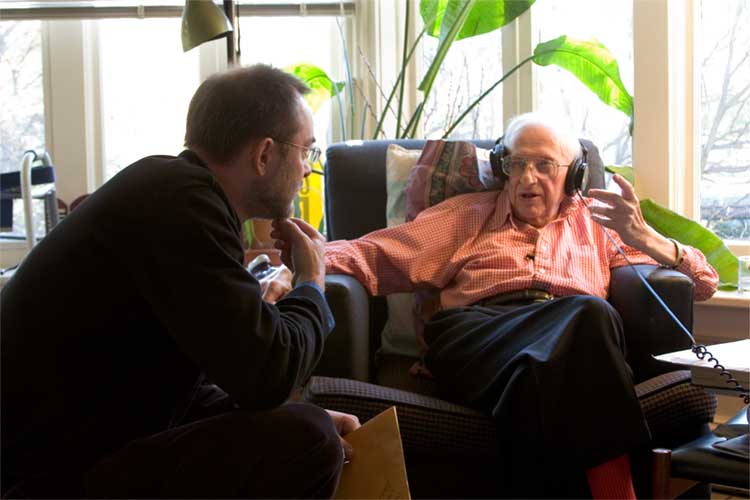
Photo: Director Paul Bonesteel talks with Studs Terkel. (Studs had just listened to a recording of an interview he conducted with Carl Sandburg in 1959)
Meeting and interviewing Studs Terkel was humbling to say the least. To interview someone who has done the same with many of the most influential people of the 20th century, was exciting and fulfilling. Studs read from Sandburg's poetry, stopping between lines to make comments and, in fact, doing a bit of Sandburg impersonation. He was especially good with his version of "The Peeeeeeeople, Yes".
I am grateful to Studs for opening his door to us and telling us his stories.
Friday, December 09, 2005
Galesburg
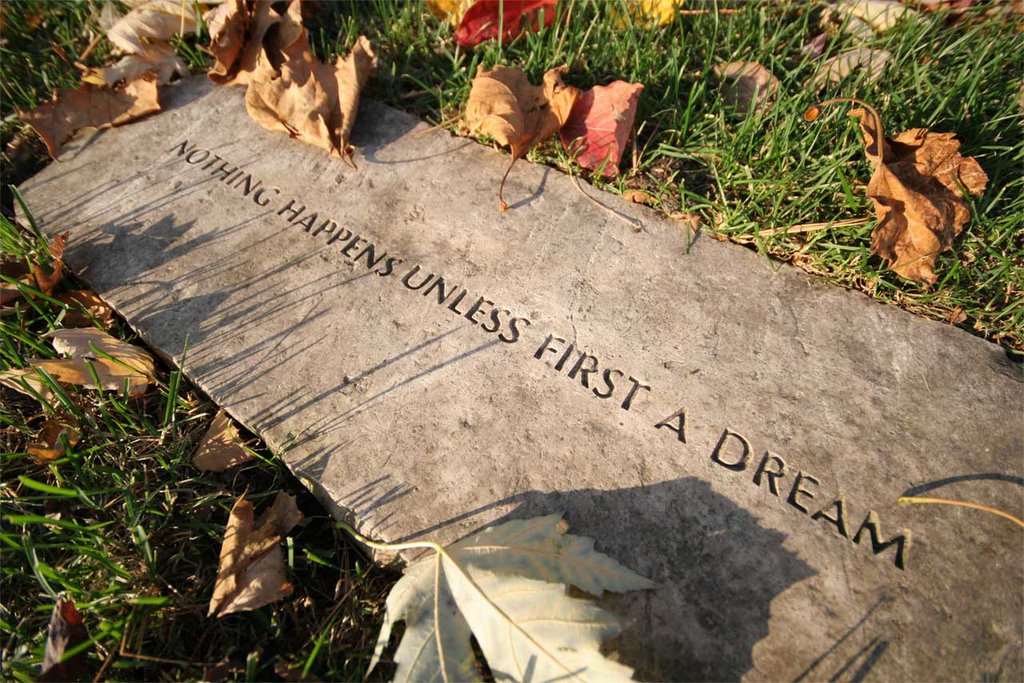
Galesburg Ill. November 2005
I love the feeling when you can sense the passage of time, what a century of years make.
The warm late fall weather betrayed the date. A few blocks away from the tiny shack Carl Sandburg was born in the trains come and go, making sounds that trains make. This is where his father toiled on steel, where Carl walked the tracks to school, delivered milk, newspapers and where his mother carried in water from the pump outside. Standing there, you can almost hear the Swedish words and accents coming from inside the house, smell the burning coal from the cooking stove that served as the only heat. This was not a place from which you'd expect a poet to emerge, but, once again, humanity surprises.
The Carl Sandburg birthplace is a State of Illinois Historic site, run by a lone employee, the director Steve Holden and assisted by a non-profit support group. It is filled with artifacts and photos, original books and a guitar. Our trip there was as much for inspiration as it was for research. We shot some images, talked with Steve, pitched our project the The Friends of Carl Sandburg group there in Galesburg and met two scholars from Knox College, an english professor, Robin Metz, and Rodney Davis of Knox College’s Lincoln Studies Center. Their input was reassuring to me that Sandburg the poet still has things to say, and that his Lincoln biographies still resonate today.
We will return at some point to conduct on-camera interviews and shoot additional footage and gather archival images.

Director Paul Bonesteel shooting Remembrance Rock, the resting place of the Sandburg's ashes
(photographs by Evan Schafer)
Thursday, December 08, 2005
Where to? What Next?

It was 1992 when I first decided to tell the Sandburg story in a documentary. I had just completed my second film called "If The People Will Lead" focusing on the journalistic and other media efforts at work in the complex story of the fall of the Soviet Union. It was an extraordinary experience being in the U.S.S.R in May of 1991, and the work that went into telling that story had given me the confidence that the time was right to take on Sandburg. A year and a dozen of so grant requests later the project had not generated any funding and had lost momentum. My efforts were put into a new documentary, called "Caribou Bones".
The truth was, I was not ready to take on a subject as vast and complex as Carl Sandburg, and I put the idea in the freezer for a while.
Fast forward to early 2004. With a half dozen other films produced, and much broader life experiences to draw upon, I decided the time was right to jump start the idea. I found my old ideas, my correspondence with Helga Sandburg Crile and others, and decided to begin again. It was my opinion that the time was right to tell Sandburg's story. The country was divided politically and socially and faced (and continues to) many of the same challenges that Carl Sandburg wrote about during his lifetime. Who better than to turn a mirror on our times than a populist poet who lived and breathed democracy with all its warts and blemishes?
I turned to Penelope Niven's Sandburg biography (which was always close at hand anyway) and a number of other books to reaquaint myself. We wrote the initial treatment for funding requests in the fall of 2004 and submitted it to many groups like NEA, NEH, PBS and others. While it was well received, it produced no funding, and I knew we had to look harder at the subject and the story we wanted to tell. It needed more controversy, it needed a more critical view of the life and times... Here in 2005, merely celebrating a substantial writer is not enough.
As always, the subject of Sandburg does not disappoint. Controversy, criticism, war, race, politics, literary feuds, pain, loss and suffering… its all here in his story.
I have since reached further into the well of scholarship on Sandburg, finding some important works, like Philip Yannella's "The Other Carl Sandburg" and Dan Zanes' recording of songs Sandburg collected in The American Songbag, called "Parades and Panoramas". These two works have further motivated me that the story of Sandburg has value and relevance today. Many other books, articles and photographs about Sandburg are serving as inspiration, as well as a growing list of prominent scholars. The team has grown into a major league ball club of consultants and interviewees. Finally, we are going to tell this story in a way that deserves national PBS distribution.
Currently we await word from about six different funding opportunities. We submitted a highly revised treatment, proposal and draft script to the National Endowment for the Humanities in November. I wish I could say that now it's wait, wait, wait... But that is not the case. Our development of the script continues as we incorporate some of the information that we are gathering.
If you've read this much thanks, I'll do my best to bring up the excitement level of the posts... I just had to cover the groundwork before moving forward.
From this point this blog may deal with topics or experiences, not exclusively linear progress. There will be events and shoots from the past that will be described, research topics pondered, and perspective sought. So, please feel free to contribute.
Where to? What Next?
(Photo: self portrait in Chicago 11.05)
Sunday, December 04, 2005
Many years in the making, already!
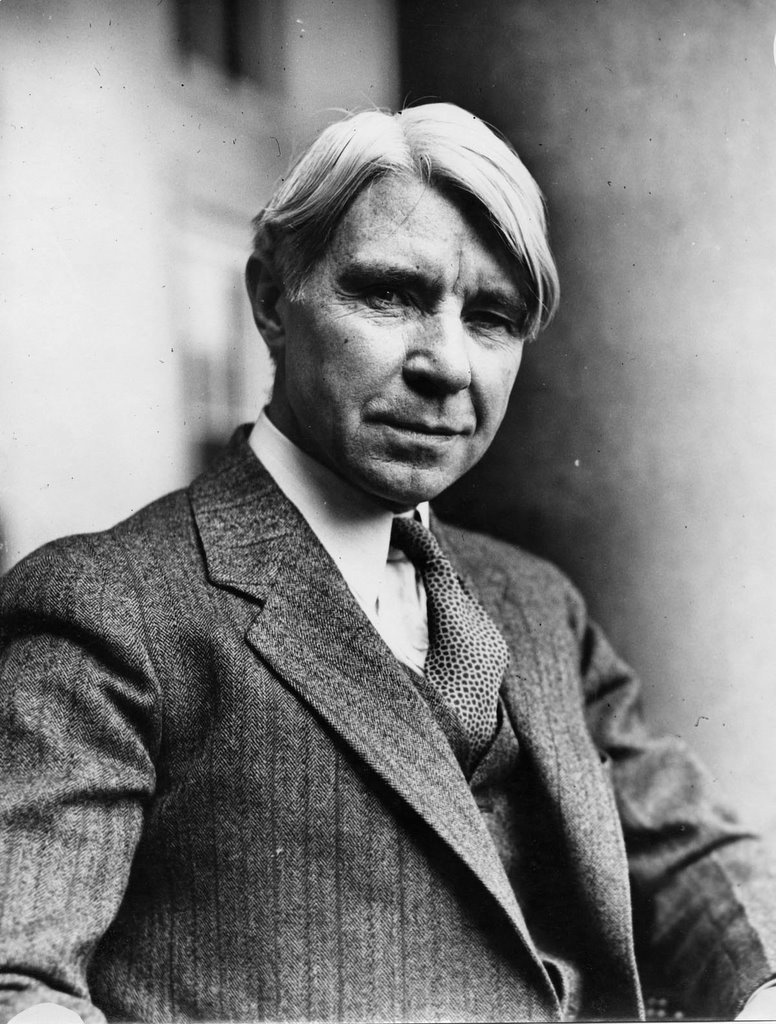
Whats this Blog all about? The making of a documentary film about Carl Sandburg.
My connection to Carl Sandburg started young. When we moved to Flat Rock, North Carolina in the early 1970's I was seven. Soon my Mom was volunteering at Connemara, the home of Carl Sandburg and his wife Paula for the last twenty or so years of his life. It had just a few years earlier been turned into a National Park and there we were, milking goats, growing vegetables in our own garden plot and exploring the houses and trails that make up the historic home and grounds. Soon I was learning how to write Haikus in the grassy fields around the house, part of a poetry class I was taking with my Sister.
Sandburg then was a distant grandfatherly figure in photos, unfathomable to some extent. But the goats were real, the cats were real, the hippy poetry teacher was real and the place seemed to have a magic about it. Sandburg seemed to me then as some sort of magician, capable of both the simplest poems and enormous books that I would'nt read for many years. There were cigar butts and papers still where he left them. Guitar strings that he had casually strummed. All of it rich with history and importance, but yet humble and tangible.
We are well on our way of telling a new and fresh story about Carl Sandburg, hopefully on PBS. We've been hard at work for the past two years (this the 'modern effort') doing research, grant writing, interviewing and team building. In the next few posts I'll go back re-cap where we've been, and bring you up to the present. Then you'll be along for the ride as we battle our way through a story that is as immense as it is wonderful, a process that is as painful as it can be long... and twists and turns that will have you begging for me to just "call me when it's done!"
Subscribe to:
Posts (Atom)